
Pearl Farming Hatchery – The Real Truth
Freshwater Mussels for Pearl Farming: Hatchery vs Wild Mussels – The Real Truth
Pearl farming is gaining attention in India as a profitable aquaculture business. However, one common question asked by beginners is: Where do freshwater mussels come from?
Are they produced in hatcheries, or are they collected from natural water bodies?
Understanding the source of mussels is extremely important for anyone interested in pearl farming. In this article, we explain the science behind freshwater mussels, their life cycle, hatchery production, and the actual sourcing methods used by pearl farmers.
What Are Freshwater Mussels Used in Pearl Farming?
Freshwater pearl culture mainly uses specific species of mussels that can produce nacre layers around an implanted nucleus. The most commonly used species in India include:
- Lamellidens marginalis
- Lamellidens corrianus
- Parreysia corrugata
These mussels are naturally found in rivers, lakes, reservoirs, and irrigation canals across India.
Unlike marine oysters, freshwater mussels thrive in inland water bodies and are suitable for pond-based pearl culture systems.
Are Freshwater Mussels Parasites?
A common misconception is that freshwater mussels are parasites. In reality, adult mussels are not parasites.
However, their larval stage called glochidia temporarily attaches to fish gills or fins. This is part of their natural reproductive cycle and usually does not harm the host fish.
After a short period, the larvae detach and settle on the pond or river bed as juvenile mussels.
Are Mussels Produced in Hatcheries?
Technically, freshwater mussels can be produced in hatcheries. The process involves:
- Breeding adult mussels
- Collecting glochidia larvae
- Attaching larvae to host fish
- Allowing metamorphosis into juvenile mussels
- Growing them in nursery systems
This process requires controlled laboratory conditions, host fish management, and specialized aquaculture expertise.
Because of these complexities, commercial mussel hatcheries are still limited in India expect research units for research purpose only! which can’t supply and meet the requirement’s!
Where Do Pearl Farmers Actually Get Mussels?
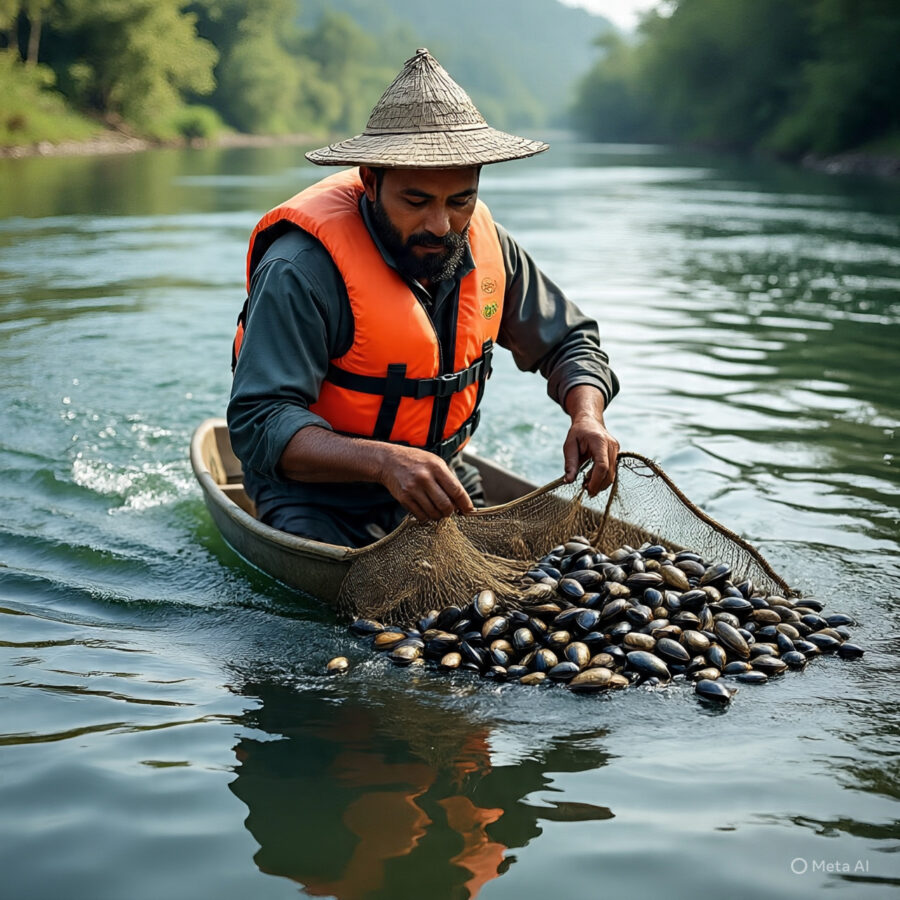
In most pearl farming operations across India, mussels are collected from natural freshwater ecosystems.
Collectors and fishermen gather mussels from:
- Reservoir beds
- Riverbanks
- Irrigation canals
- Large lakes
These wild-collected mussels are then supplied to pearl farmers through local aquaculture networks.
States where mussels are commonly sourced include Karnataka, Tamil Nadu, Telangana, West Bengal, and Uttar Pradesh.
Are Mussel Hatcheries Profitable?
Mussel hatcheries face several economic challenges:
- Slow growth cycle of 2–3 years
- Complex life cycle involving fish hosts
- High infrastructure requirements
- Low selling price of mussels
Because natural mussels are widely available at low cost, hatcheries currently struggle to compete economically.
However, in the future, hatcheries may become important as pearl farming expands and wild mussel availability decreases.
Price of Mussels for Pearl Farming
Freshwater mussels are generally affordable for pearl farmers. Prices vary depending on size and location.
- Small Mussels (6–8 cm): ₹5 – ₹8
- Medium Mussels (8–10 cm): ₹10 – ₹15
- Large Mussels (10–12 cm): ₹20 – ₹30
This affordability makes pearl farming an attractive opportunity for farmers and entrepreneurs.
The Future of Mussel Hatcheries
Research institutes in India are developing technologies to produce freshwater mussels in hatcheries.
One such institute is the Central Institute of Freshwater Aquaculture (CIFA), which has conducted research on mussel breeding and pearl culture technology.
As pearl farming grows in India, hatcheries may become an important part of the industry.
Final Thoughts
Pearl farming is a fascinating combination of biology, aquaculture, and entrepreneurship.
While hatchery production of freshwater mussels is scientifically possible, most pearl farmers today rely on naturally sourced mussels.
Understanding mussel biology, sourcing methods, and proper pearl culture techniques is essential for successful pearl farming.
With proper training and scientific knowledge, pearl farming can become a sustainable and profitable aquaculture venture.

0 Comments
No comments yet. Be the first to comment!