
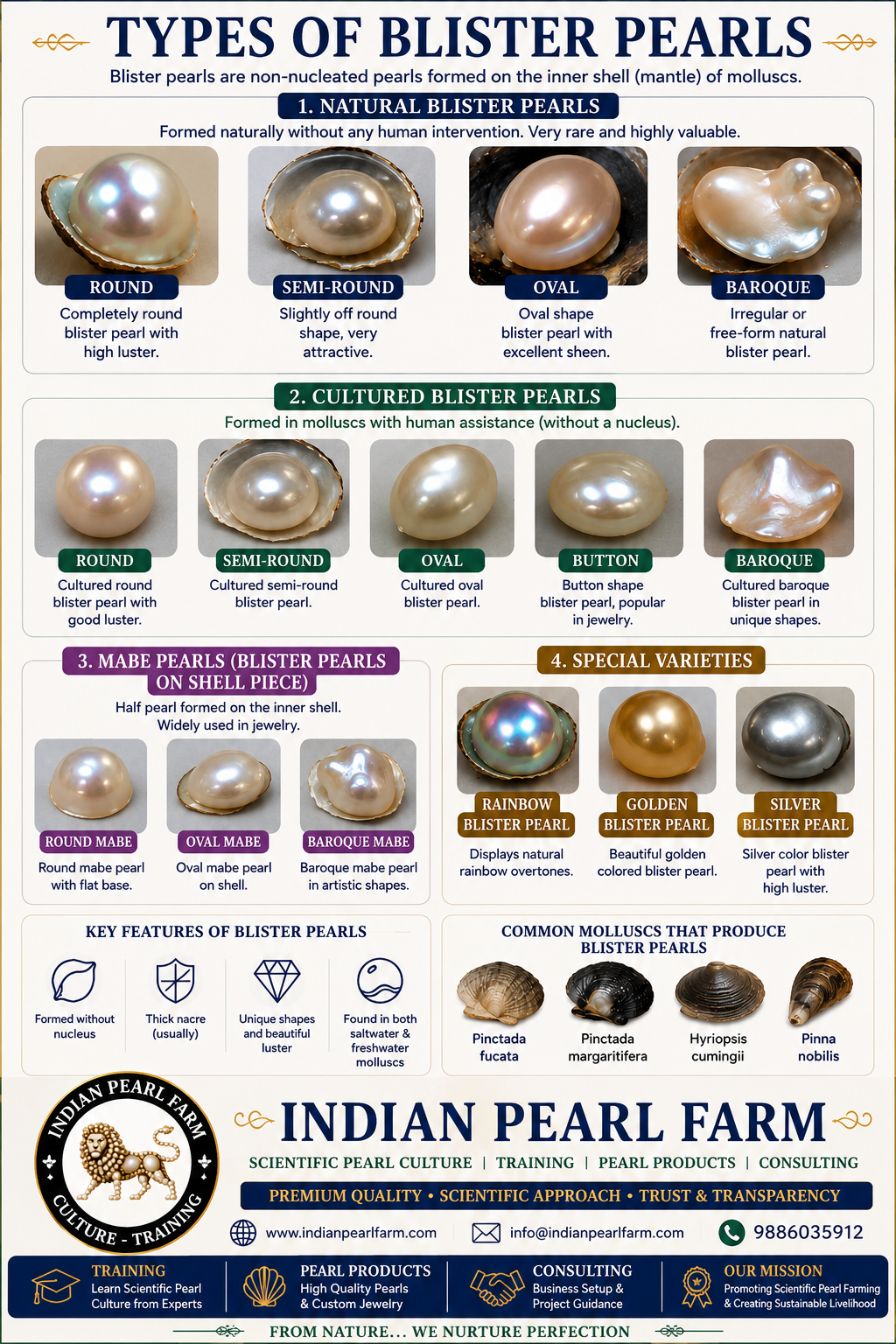
Blister Pearls – Formation and Cultivation
Blister pearl Types, Value & Business Potential
Introduction to Blister Pearls
Blister pearls are one of the most fascinating forms of pearls found in the world of pearl culture and natural pearl formation. Unlike traditional free-form pearls that develop inside the soft tissue of a mollusk, blister pearls grow attached to the inner shell of the mollusk. Their unique attachment to the shell creates a dome-shaped appearance, making them visually distinctive and commercially valuable for jewelry and decorative applications.
Blister pearls have gained popularity in modern pearl farming because they are easier to cultivate in certain species of mussels and oysters. They also provide excellent opportunities for designers, artisans, and pearl farming entrepreneurs looking for niche markets.
In recent years, the growing interest in scientific pearl culture and designer pearls has increased demand for blister pearls in India and international markets
What is a Blister Pearl?
A blister pearl is a pearl that forms while attached to the inner shell surface of a mollusk instead of developing freely within the tissue.
The pearl develops when an irritant becomes trapped between the shell and mantle tissue. Over time, layers of nacre are deposited around the irritant, creating a pearl that is fused with the shell.
Key Characteristics of Blister Pearls
- Attached to the shell
- Dome or half-spherical shape
- Flat backside
- Strong nacre coating
- Unique artistic appearance
- Used mainly in jewelry and craft work
Natural Blister Pearls vs Cultured Blister Pearls
Natural Blister Pearls
Natural blister pearls occur without human intervention. Sand particles, parasites, or shell injuries trigger nacre formation naturally.
These pearls are extremely rare and can have antique or collectible value depending on their origin and quality.
Cultured Blister Pearls
Cultured blister pearls are produced through scientific pearl farming techniques.
In cultured pearl production:
- A nucleus or object is attached near the shell interior
- The mollusk deposits nacre around the object
- The pearl grows attached to the shell
This method is commonly used in commercial pearl farming.
How Blister Pearls are Formed
Step-by-Step Formation Process
1. Irritant Entry
A foreign object enters the shell or is intentionally inserted.
2. Mantle Reaction
The mollusk reacts defensively by coating the irritant with nacre.
3. Nacre Deposition
Layer after layer of nacre accumulates around the irritant.
4. Attachment to Shell
Unlike round pearls, the pearl remains attached to the shell wall.
5. Pearl Development
Over months or years, the blister pearl increases in size and luster.
Types of Blister Pearls
1. Natural Blister Pearls
Rare pearls naturally formed in wild mollusks.
2. Cultured Blister Pearls
Scientifically cultivated using pearl farming techniques.
3. Mabe Pearls
A popular category of blister pearls where the pearl is later cut from the shell and backed with resin or mother-of-pearl.
4. Designer Blister Pearls
Custom-shaped pearls created for artistic jewelry applications.
Species Used for Blister Pearl Production
Different mollusk species are used worldwide.
Freshwater Mussels
Common in freshwater pearl farming.
Saltwater Oysters
Used for premium blister pearl production.
Mabe Pearl Oysters
Special species cultivated specifically for Mabe pearls.
Blister Pearl Farming Process
1. Water Quality Management
Water quality is the foundation of successful pearl farming.
Important Parameters
- pH: 7.0 – 8.5
- Temperature: 20°C – 30°C
- Dissolved Oxygen: Good aeration required
- Ammonia: Minimal levels
- Clean and stable water conditions
Poor water quality leads to:
- Mussel mortality
- Weak nacre formation
- Poor luster
- Infection and shell damage
2. Selection of Healthy Mussels
Healthy mussels are essential for successful blister pearl production.
Selection Criteria
- Active mussels
- No shell cracks
- Healthy mantle tissue
- Medium to large size
3. Preparation of Nucleus
A nucleus or mold is selected based on desired pearl shape.
Common Nucleus Materials
- Plastic molds
- Shell beads
- Designer shapes
4. Surgical Implantation
The implantation process requires technical skill and precision.
Procedure
- Shell is gently opened
- Nucleus is attached to shell interior
- Mantle tissue contact is ensured
- Mussel is placed in recovery system
Improper implantation may lead to:
- Rejection of nucleus
- Death of mussel
- Poor nacre coating
5. Post-Surgery Care
Recovery management is critical.
Important Practices
- Maintain clean water
- Proper aeration
- Reduce stress
- Avoid overcrowding
- Monitor survival rate
6. Growth Period
Blister pearls generally require:
- 6 months to 2 years
depending on:
- Species
- Water quality
- Feeding
- Pearl size goals
7. Harvesting
Harvesting must be performed carefully.
Process
- Shell is opened
- Pearl section is cut carefully
- Surface cleaned and polished
Advantages of Blister Pearl Farming
1. Easier Shape Control
Farmers can create specific pearl designs.
2. Higher Artistic Value
Unique shapes increase designer demand.
3. Lower Risk Compared to Round Pearls
Some species accept blister nuclei more easily.
4. Better Commercial Opportunities
Excellent for jewelry and crafts.
5. Innovation Potential
Possibility of customized pearls.
Challenges in Blister Pearl Farming
1. Technical Skill Requirement
Improper implantation reduces success.
2. Water Quality Sensitivity
Water management remains critical.
3. Market Awareness
Many customers are unaware of blister pearl value.
4. Time Investment
Pearl growth requires patience.
Blister Pearl Jewelry Market
Blister pearls are increasingly used in:
- Designer jewelry
- Handcrafted ornaments
- Luxury pendants
- Artistic rings
- Fashion accessories
- Custom pearl artwork
Their unusual appearance makes them highly attractive in modern jewelry design.
Business Opportunities in Blister Pearl Farming
1. Pearl Farming Business
Commercial cultivation and pearl sales.
2. Jewelry Manufacturing
Creating custom jewelry collections.
3. Training & Consultancy
Teaching scientific pearl farming.
4. Designer Pearl Exports
Supplying niche pearl products globally.
5. Tourism & Demonstration Farms
Educational and experiential pearl farms.
Blister Pearls in India
India is witnessing growing awareness in:
- Freshwater pearl farming
- Scientific pearl culture
- Designer pearl production
- Entrepreneur-driven aquaculture businesses
With proper technical guidance and water management, blister pearl farming has potential to become a profitable niche industry.
Difference Between Round Pearls and Blister Pearls
| Feature | Round Pearls | Blister Pearls |
|---|---|---|
| Formation | Inside tissue | Attached to shell |
| Shape | Round | Dome-shaped |
| Backside | Fully round | Flat |
| Cultivation | More difficult | Relatively easier |
| Jewelry Use | Traditional | Designer & artistic |
| Commercial Value | High | Specialized niche value |
Important Facts About Blister Pearls
- Blister pearls are real pearls
- They contain nacre layers
- They can be natural or cultured
- Mabe pearls are a form of blister pearls
- Designer blister pearls have growing market demand
Future of Blister Pearl Farming
The future of blister pearl farming looks promising because:
- Designer jewelry demand is increasing
- Customized pearls are trending
- Scientific pearl culture awareness is growing
- Aquaculture entrepreneurship is expanding
Entrepreneurs who combine:
- technical knowledge,
- water quality management,
- marketing,
- and innovative product development
can build sustainable businesses in this sector.
Conclusion
Blister pearls represent a beautiful combination of nature, science, and artistic creativity. Their unique formation and growing commercial value make them an exciting opportunity in modern pearl farming.
Whether for jewelry production, scientific farming, or niche business development, blister pearl culture offers immense potential when approached with proper technical knowledge and ethical farming practices.
As pearl farming evolves in India and globally, blister pearls may become one of the most innovative and profitable segments in the pearl industry.
About Indian Pearl Farm
Indian Pearl Farm focuses on scientific pearl culture training, practical implementation, entrepreneurship development, and awareness about modern pearl farming opportunities.
For Training & Consultancy:
Phone: +91 9886035912 Website: www.indianpearlfarm.in

0 Comments
No comments yet. Be the first to comment!