
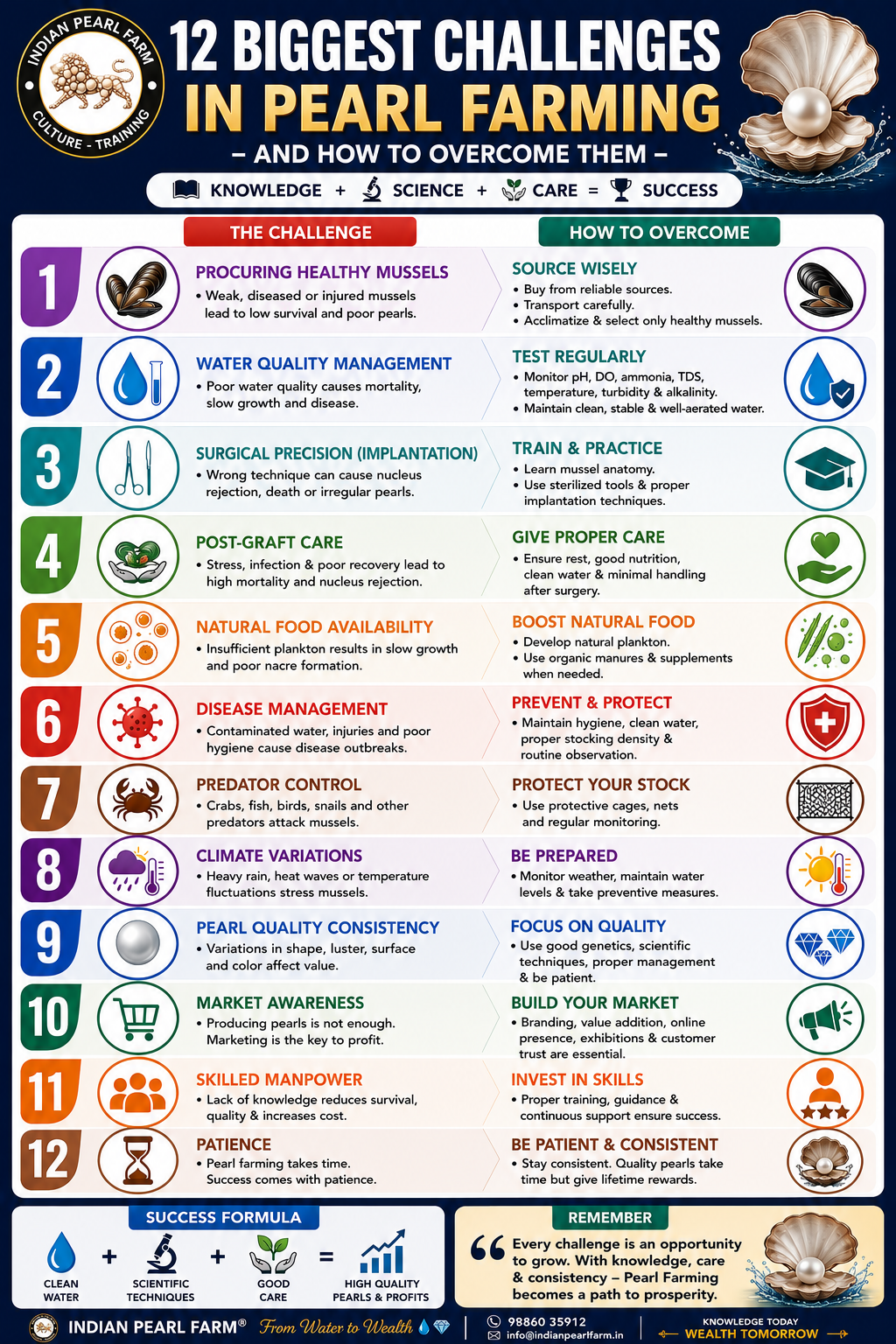
Common Problems and Practical Solutions in Pearl Farmings
How to Succeed in Pearl Farming
Understanding the Reality Behind India’s Emerging Blue Economy
Pearl farming is often portrayed as a highly profitable business, and while it certainly has tremendous potential, success does not come by chance. Like any scientific aquaculture practice, pearl farming presents its own set of challenges that require proper knowledge, planning, and management.
The good news is that almost every challenge in pearl farming has a practical solution when the right techniques are followed.
At Indian Pearl Farm®, we believe in preparing entrepreneurs for both the opportunities and the realities of pearl farming.
1. Procuring Healthy Mussels
Challenge
The quality of the final pearl depends largely on the health of the mussel. Poor-quality, diseased, or stressed mussels can result in low survival rates and poor pearl formation.
Common Problems
- Weak mussels
- Injured shells
- Disease infections
- Improper transportation
- Long-distance procurement stress
Solution
✔ Procure mussels from reliable sources.
✔ Transport them carefully.
✔ Acclimatize them before implantation.
✔ Select only healthy specimens.
2. Water Quality Management
Challenge
Water is the foundation of pearl farming.
Poor water quality leads to:
- High mortality
- Slow nacre formation
- Poor pearl quality
- Disease outbreaks
Parameters to Monitor
- pH
- Temperature
- Dissolved Oxygen
- Ammonia
- Turbidity
- TDS
- Alkalinity
Solution
Regular water testing and corrective management ensure a healthy culture environment.
3. Surgical Precision
Challenge
Pearl implantation is one of the most delicate procedures.
Even a small mistake can lead to:
- Nucleus rejection
- Mussel death
- Poor pearl formation
- Irregular pearls
Solution
Scientific training and repeated practice are essential. Understanding mussel anatomy, maintaining sterile tools, and using proper implantation techniques greatly improve success.
4. Post-Graft Care
Many beginners assume that surgery is the hardest part.
In reality, the real challenge begins after implantation.
Risks
- Stress
- Infection
- Mortality
- Nucleus rejection
Solution
- Proper recovery
- Adequate feeding
- Stable water quality
- Minimal handling
5. Natural Food Availability
Mussels survive by filtering microscopic organisms from water.
Challenge
Insufficient plankton results in:
- Slow growth
- Poor nacre formation
- Reduced pearl quality
Solution
Develop natural plankton populations and supplement nutrition whenever necessary.
6. Disease Management
Like every aquaculture system, pearl farming faces biological risks.
Causes
- Contaminated water
- Injured mussels
- Poor hygiene
- Overstocking
Prevention
✔ Clean water
✔ Sterilized equipment
✔ Proper stocking density
✔ Routine observation
7. Predator Control
Many natural predators attack mussels.
Examples include:
- Crabs
- Fish
- Birds
- Snails
- Rats
- Frogs
Solution
Protective cages, proper netting, and regular monitoring help reduce losses.
8. Climate Variations
Sudden weather changes can stress mussels.
Challenges
- Heavy rainfall
- Heat waves
- Water level fluctuations
- Temperature shocks
Solution
Monitor environmental conditions and take preventive measures before extreme weather events.
9. Pearl Quality Consistency
Every pearl is unique.
Even under identical conditions, pearls can differ in:
- Shape
- Luster
- Surface quality
- Color
- Thickness
Solution
Quality improves through:
- Scientific implantation
- Good genetics
- Proper management
- Patience
10. Market Awareness
Many new farmers believe that simply producing pearls guarantees profit.
The reality is different.
Success Depends On
- Branding
- Jewellery making
- Value addition
- Online marketing
- Customer trust
11. Skilled Manpower
Pearl farming requires trained hands.
Without proper knowledge:
- Survival decreases.
- Quality drops.
- Costs increase.
Solution
Invest in skill development before investing in infrastructure.
12. Patience
Unlike many businesses, pearl farming requires time.
Round pearls may take over two years to develop, while designer pearls can take around one to one-and-a-half years.
Those who remain patient often produce better-quality pearls and build more sustainable businesses.
Biggest Myth About Pearl Farming
Many people believe:
“I will start pearl farming today and earn lakhs within a few months.”
This is one of the biggest misconceptions.
Pearl farming is a scientific enterprise that demands planning, consistent care, and long-term commitment. When managed professionally, it can become a rewarding and sustainable source of income.
How Indian Pearl Farm Helps
Indian Pearl Farm® supports entrepreneurs through:
- Scientific training
- Practical demonstrations
- Farm consultancy
- Pond design guidance
- Business planning
- Jewellery making
- Marketing support
- Continued mentorship
Our objective is not merely to train individuals, but to help build successful pearl farming enterprises.
Final Thoughts
Every successful pearl begins as a tiny challenge inside a mussel.
Similarly, every successful pearl farmer overcomes challenges through learning, discipline, and persistence.
Challenges are not barriers—they are opportunities to improve.
Remember Our Philosophy
💧 Water + Science + Skill = Wealth
Skill First. Investment Later. Success Forever.
Contact Indian Pearl Farm®
📞 9886035912
From Water to Wealth

0 Comments
No comments yet. Be the first to comment!