Pearl Farming Training in Delhi
Turn Water into Wealth | Practical Pearl Farming Training | Business Guidance & Consultancy
Are you looking for an innovative agricultural business opportunity in Delhi? Are you a farmer, entrepreneur, student, working professional or aspiring business owner interested in exploring a new field beyond conventional agriculture?
Pearl farming could be an opportunity worth understanding. With the right technical knowledge, suitable water resources, appropriate infrastructure and proper farm management, freshwater pearl cultivation can be explored as a specialised aquaculture activity.
Indian Pearl Farm® offers pearl farming training, practical demonstrations, technical guidance and consultancy to help aspiring entrepreneurs understand this specialised field before making investment decisions.
If you are searching for pearl farming training in Delhi, pearl cultivation courses, pearl farming business guidance or professional pearl farming consultancy, Indian Pearl Farm can help you take your first informed step.
Why Explore Pearl Farming in Delhi?
Delhi and the surrounding National Capital Region (NCR) have farmers, landowners, entrepreneurs, educational institutions and individuals interested in alternative business opportunities.
For those with access to suitable water resources and space, freshwater pearl farming may be worth investigating as part of a carefully planned aquaculture project.
Potential areas of interest include:
- Agricultural diversification: Explore an alternative to conventional farming activities.
- Entrepreneurship: Learn about the technical and commercial aspects of pearl cultivation.
- Skill development: Acquire specialised knowledge in freshwater mussel culture and pearl implantation.
- Value addition: Understand pearl grading, jewellery applications and product marketing.
- Integrated farming: Investigate whether pearl cultivation can complement an existing farm, subject to site suitability.
- Knowledge-led investment: Assess the technical requirements before committing capital.
However, pearl farming is not a guaranteed-profit or quick-income business. Success depends on several factors, including mussel health, implantation skills, water quality, survival rates, culture duration, pearl quality, operating costs and access to buyers.
The first step is not building a pond. The first step is learning the science and evaluating your resources.
What Is Freshwater Pearl Farming?
Freshwater pearl farming involves cultivating pearls in suitable freshwater mussels under managed conditions.
Depending on the technique and objectives, pearl culture can involve different implantation methods and the production of pearls with different shapes, designs and characteristics.
The process generally involves:
- Selecting suitable freshwater mussel species.
- Assessing water quality and preparing the culture environment.
- Handling mussels carefully and understanding their biological requirements.
- Learning appropriate implantation and surgical techniques.
- Managing mussels during the culture period.
- Monitoring water conditions, health and survival.
- Harvesting and evaluating the resulting pearls.
- Grading, developing marketable products and exploring sales channels.
Each stage requires technical understanding and careful execution. Practical training is particularly important because successful implantation and post-operative care depend on skill, suitable materials and correct procedures.
Can Pearl Farming Be Started in Delhi?
Potentially, yes—but suitability must be established for the specific site.
Delhi’s climate, seasonal temperature variations, water availability and local site conditions need to be considered before planning a freshwater pearl farm. Conditions in Delhi may differ from those at an established pearl farm in Karnataka.
Before starting, prospective farmers should assess:
- Availability and reliability of freshwater throughout the year.
- Water pH, hardness, alkalinity, dissolved oxygen and ammonia.
- Seasonal water-temperature variations.
- Water source, treatment requirements and possible contamination.
- Suitable mussel species and their environmental requirements.
- Space for culture tanks, tubs or ponds.
- Electricity, water circulation and other infrastructure requirements.
- Local permissions and applicable environmental or aquaculture regulations.
- Project costs, operating expenses and potential market access.
A site that works well in one region may require different management or infrastructure in another.
For this reason, Indian Pearl Farm recommends site-specific assessment and technical planning before large-scale investment. Water testing, infrastructure evaluation and small-scale trials can help identify challenges before a project is expanded.
Indian Pearl Farm® – Your Learning Partner in Pearl Farming
Indian Pearl Farm® is focused on practical pearl farming education, technical knowledge, skill development and business guidance.
Located near Nandi Hills in Karnataka, Indian Pearl Farm combines farm-based learning with practical demonstrations and guidance on the different stages of pearl cultivation.
The objective is to help participants understand not only how pearl culture works, but also what it takes to plan and manage a pearl farming enterprise.
What Makes Our Training Valuable?
1. Practical learning, not theory alone
Participants learn about pearl farming processes through explanations and practical demonstrations designed to connect technical concepts with actual farm operations.
2. Understanding implantation techniques
Pearl implantation is one of the specialised skills in pearl cultivation. Training introduces participants to relevant tools, materials, procedures and techniques through guided demonstrations and practical learning.
3. Understanding farm management
Learn why water quality, mussel handling, culture conditions, routine maintenance and survival monitoring matter throughout the cultivation cycle.
4. Understanding the commercial journey
Pearl farming is not complete at harvesting. Pearl quality, grading, product development, pricing, marketing and buyer relationships also influence the commercial outcome.
5. Guidance before investment
Learn about the resources, infrastructure and skills required before deciding whether pearl farming is appropriate for your circumstances.
6. Continued learning and support
Indian Pearl Farm offers guidance to help trainees continue developing their understanding beyond the training session. The scope of support depends on the applicable training package.
What Will You Learn in Pearl Farming Training?
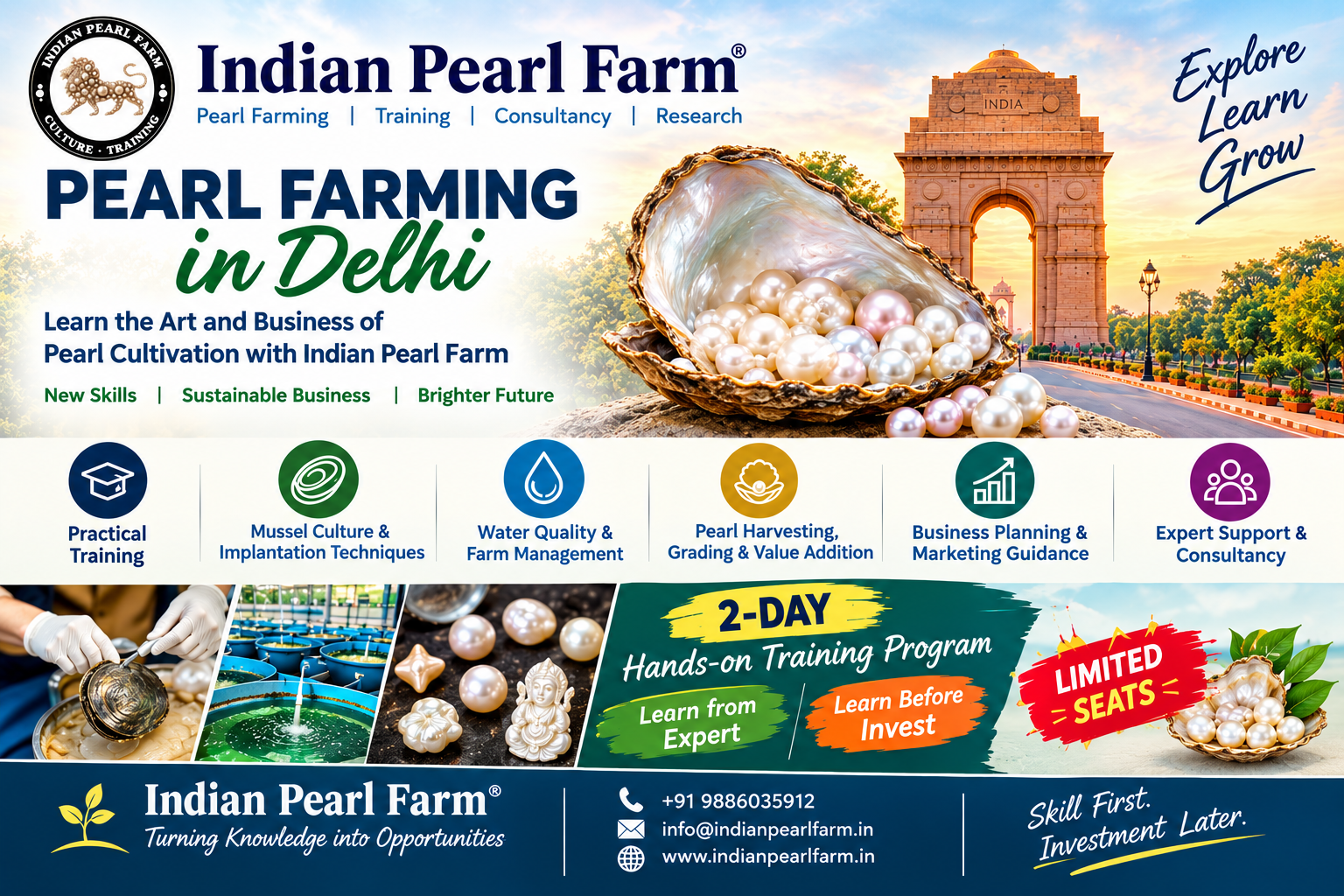
Indian Pearl Farm’s two-day training program is designed to introduce participants to important technical and business aspects of pearl farming.
The learning areas include:
- Introduction to freshwater pearl farming.
- Mussel anatomy, selection and handling.
- Tools, equipment and implantation materials.
- Pearl implantation methods and practical demonstrations.
- Pond or tank preparation and water management.
- Culture maintenance and post-implantation care.
- Harvesting concepts and pearl evaluation.
- Pearl grading and quality considerations.
- Marketing, pricing and potential sales channels.
- Farm planning and business considerations.
The precise practical activities depend on the training format, available facilities and program arrangements.
For individuals from Delhi, travel to the Indian Pearl Farm facility near Nandi Hills, Karnataka, is one option. Institutional training may also be discussed for colleges, agricultural organisations, entrepreneurs and groups seeking training at their own venue.
Pearl Farming Business Opportunities for Delhi Entrepreneurs
Pearl farming may be explored by different categories of aspiring entrepreneurs.
Farmers and landowners: Those with suitable land and reliable water resources may investigate whether pearl cultivation can complement their existing agricultural activities.
Young entrepreneurs: Individuals seeking specialised skills can first learn the technical process and then assess whether the business fits their resources and goals.
Students and educational institutions: Pearl farming can provide exposure to aquaculture, mollusc biology, practical skills and agricultural entrepreneurship.
Women-led enterprises and rural development organisations: With appropriate training, infrastructure, technical support and a viable business model, pearl cultivation may be evaluated as a skill-development or livelihood initiative.
Existing aquaculture operators: Operators may investigate whether pearl culture fits their facilities, water conditions, technical capabilities and commercial objectives.
No single model suits everyone. A project should be planned around the actual site, available resources, target production method and market strategy.
From Pearl Cultivation to Pearl Jewellery and Value Addition
An additional area worth exploring is pearl-based value addition.
After harvest, suitable pearls may be evaluated for jewellery and decorative applications, depending on their characteristics and quality. Knowledge of grading, design, product development and marketing can help entrepreneurs understand the wider pearl value chain.
Indian Pearl Farm also focuses on pearl jewellery-making knowledge and mother-of-pearl applications, helping participants explore opportunities beyond cultivation alone.
The broader vision is to understand the journey from mussel culture to pearl production, value addition and market development.
However, pearl quality and saleability vary, and value-added products still require quality control, design, pricing and an effective route to customers.
Why Training Before Investment Matters
Imagine investing in tanks, water systems, equipment and mussels before understanding implantation techniques, water requirements or the likely costs of operating the farm.
A lack of technical preparation can lead to avoidable mistakes and financial losses.
A better approach is to learn first, evaluate the site, understand the process, prepare a realistic budget and then make an informed decision.
At Indian Pearl Farm®, our guiding principle is:
“Skill First. Investment Later.”
Training cannot guarantee commercial success, but it can help you understand the process, identify important risks and make better-informed decisions.
How to Get Started with Indian Pearl Farm®
If you are based in Delhi or the NCR and interested in pearl farming, follow these steps:
- Understand the basics: Learn about freshwater pearl culture, mussels, implantation and farm management.
- Attend practical training: Gain an understanding of the technical processes and their requirements.
- Evaluate your resources: Assess your land, water, infrastructure, budget and available time.
- Seek a site assessment: Obtain suitable water testing and technical guidance for your proposed location.
- Prepare a project plan: Estimate infrastructure, operating costs, production risks and marketing requirements.
- Start at an appropriate scale: Consider a small trial where technically feasible before expanding.
- Develop a market strategy: Investigate product quality, potential customers, pricing and sales channels.
Indian Pearl Farm can help you explore the training and consultancy options relevant to your requirements.
Book Your Pearl Farming Training or Consultancy
Whether you are an individual from Delhi interested in learning a new skill, a farmer exploring agricultural diversification, an institution planning a training program or an entrepreneur evaluating a pearl farming project, Indian Pearl Farm welcomes enquiries.
Learn the process. Understand the risks. Plan with knowledge.
Contact us to enquire about upcoming training programs, farm visits, institutional training and project consultancy.
Final Thought
Delhi has people looking for new skills and business possibilities. Pearl farming may be worth exploring for those willing to learn the technical requirements, assess their resources and approach the opportunity realistically.
You do not need to begin with a large investment. Begin with the right questions, the right knowledge and a clear understanding of what the project demands.
Indian Pearl Farm® — Turning Knowledge into Skills, and Skills into Opportunities.
0 Comments
No comments yet. Be the first to comment!